Anatomy of an eviction
Sometimes an unfair eviction is just what it seems


On Friday morning, in the WA Supreme Court, an eviction was halted. Lawyers for Nicola Torres, a single mother of teenage daughters living in a community housing tenancy, argued that magistrates had been wrong to twice dismiss her appeals against a court order terminating her tenancy late last year. Lawyers for Nicola’s landlord Foundation Housing noted that their client had agreed not to evict the family until the conclusion of the Supreme Court proceedings, with a final hearing listed for two months’ time.
Nicola was not in the courtroom. She was back at her house on a quiet street in Forrestfield in the eastern suburbs of Perth, where a makeshift picket line had held off a bailiff for the past ten days. When I drove out there after court it was all quiet, a new caravan in the driveway and packing boxes and a few camp chairs in the carport. Nicola had already left to pick up her daughter and bring her home for the first time in weeks.
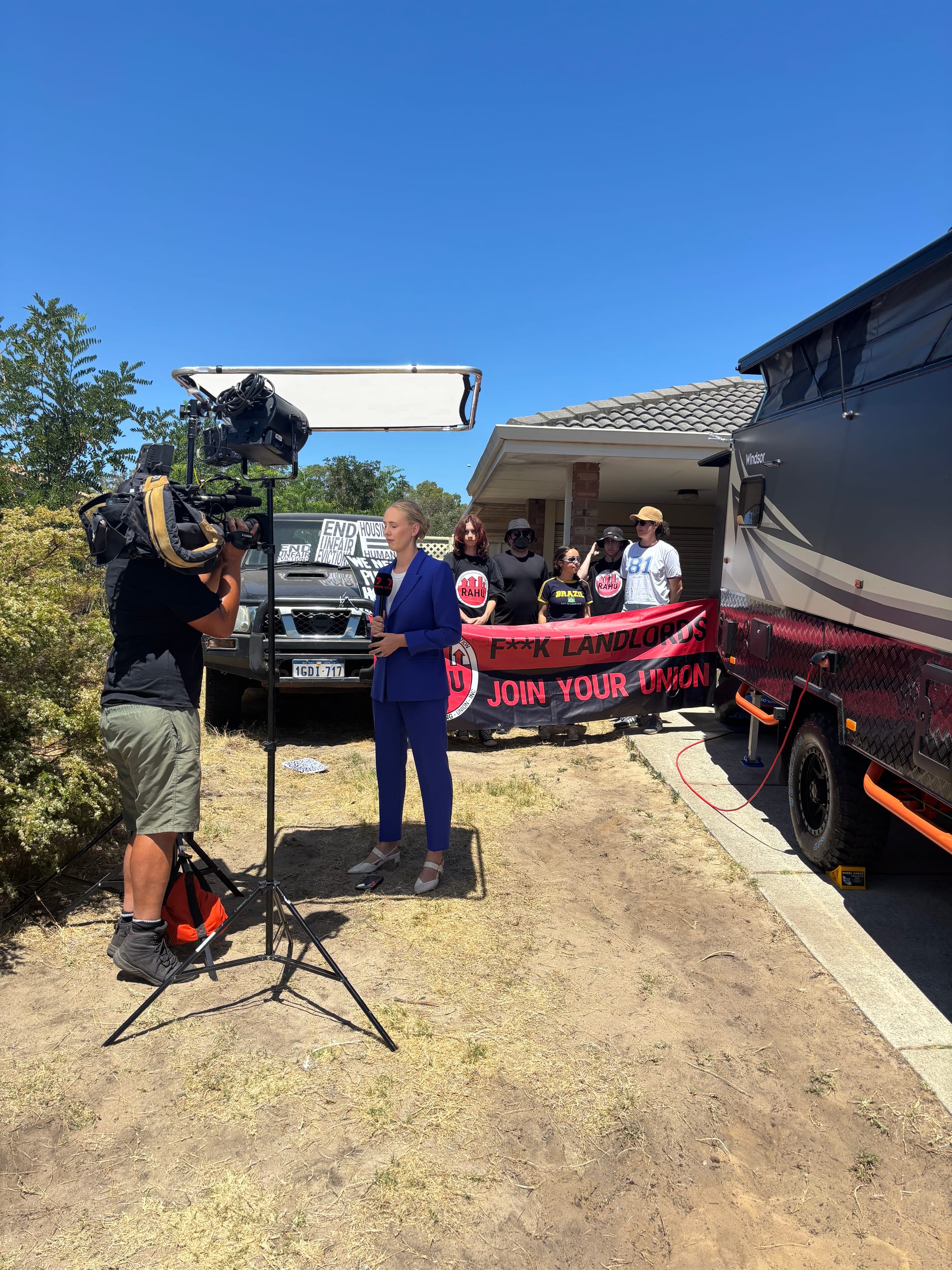
The previous Tuesday, the first of 2026, that carport had been crowded. Protestors held signs and strung banners between cars parked on the verge. White SUVs filled with TV camera crews idled their engines in the driveways of neighbouring properties. Greens MP Tim Clifford broke down as he addressed the cameras at a press conference in front of the house. “I’m sick of this shit,” he said, recounting his own experience growing up in public housing. “We're here to tell the state government that this is a political choice. You can choose to either evict people out of their homes, or you can intervene and stop this from happening.”
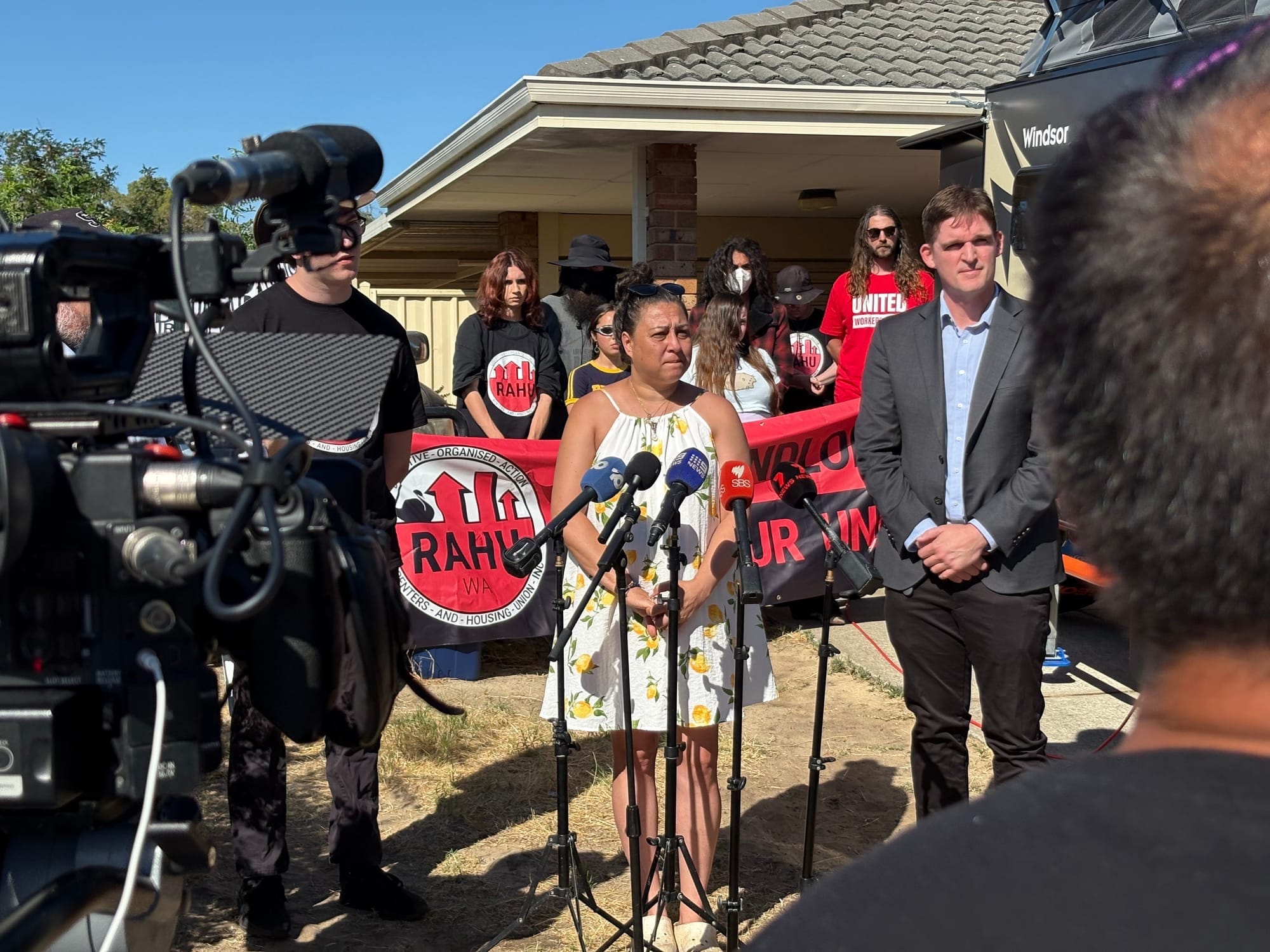
Nicola has lived at the home for the past four years with her teenage daughters. For most of that period she had steady employment, including a previous job with the Department of Housing. However, she also has a history of trauma and domestic violence. She has been diagnosed with post-traumatic stress disorder, major depression and anxiety. At some point last year, she became too ill to work, while continuing to care for her daughters.
Social housing rent is typically charged at 30% of a tenant’s income. In Nicola's case, when her income suddenly stopped her rent remained the same, and she fell into arrears. Foundation Housing have claimed that they repeatedly requested updated income details from Nicola last year - she disputes this, and says she responded to requests promptly. Either way, by the back end of 2025 she was thousands of dollars behind, and instead of finding ways to engage Nicola and support to resolve the issue, Foundation Housing chose to evict her family.
So far so normal. Every year in Western Australia, hundreds of families are evicted from public housing. In the first six years of the current Labor government, more than 3,000 children were evicted to homelessness by the government. Figures released to the WA Greens in Parliament last year show the eviction rate in community housing, where government-funded housing providers like Foundation Housing manage the tenancies in housing that is typically leased by the government, is more than five times higher than in public housing. Notwithstanding the grim numbers, Nicola’s case is still extraordinary.
That’s because, unusually for someone in her situation, Nicola paid off the entire rental arrears within days of the last hearing in the Magistrates Court - and her landlord refused to accept it. I have seen an email from Foundation Housing confirming they received a lump sum payment from Nicola in early December, and requesting her bank details to send the money back. I’ve also seen a bank statement showing those transactions. Nicola used the money to buy a caravan instead, figuring that would soon be the best shelter she’d have.
In spite of Nicola’s repayment, and strenuous appeals from advocates to reconsider, Foundation Housing pressed ahead. CEO Chris Smith said in a statement that "where tenancy matters proceed through the courts, Foundation Housing has obligations to act in accordance with court decisions." The organisation did not respond to questions about which law required them to enforce the eviction, given that the Housing Minister is often at pains to point out that the Department of Housing works to resolve tenancy issues even after the matter has been to court. According to answers provided in Parliament, the WA government issued almost 3000 termination notices to public housing tenants last year, with only a small fraction proceeding to eviction.
In this case, however, the WA Housing Minister John Carey resisted calls to intervene and instead called an extraordinary press conference to lash out at Nicola, stepping out of the government’s office with the Foundation Housing CEO beside him to address media.
Repeatedly, the Housing Minister claimed that Nicola’s case had already been before the court three times, and each time the court upheld the decision to evict. “This decision has been considered three times by a magistrate,” Carey claimed. “And on the evidence before that magistrate, they have decided that an eviction still stands.”
I’ve seen the transcripts of each of the three hearings. The first, the hearing where Nicola’s tenancy was terminated, is copied below in its entirety. Nicola says she turned up to court late, by which time the court order had been made by a registrar - not a magistrate, but a court official who does not require a legal degree - in her absence. The hearing lasted one minute. Nicola immediately appealed the same day.
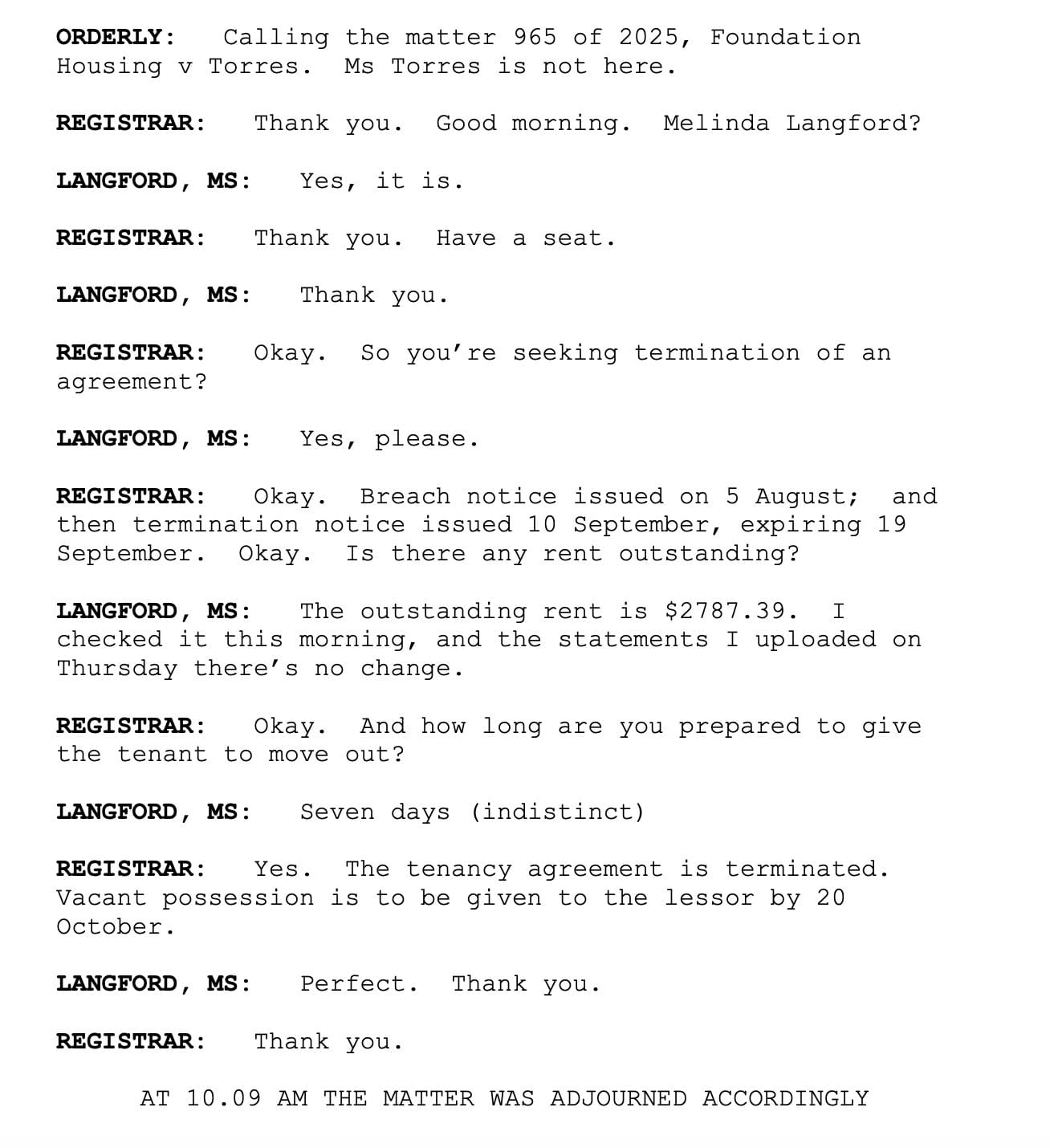
The second hearing a few weeks later is a stressful and heated affair, where Nicola and the magistrate talk over each other as he insists that she has not filed the correct appeal form. As her case is dismissed, Nicola’s final words on the transcript are “I can’t breathe.” These hearings, as well as a third one where Nicola finally had an advocate to represent her, will be the subject of the Supreme Court review in March.
But the Housing Minister went further. “The tenant has not provided required evidence about her income and previously had misrepresented her income levels,” he alleged, presumably relying on information given to him by Foundation Housing’s CEO that wasn’t shared publicly. “I'm advised that there has been repeated abuse of staff,” the Minister continued. Nicola could only recall one instance she had become upset with Foundation Housing staff, after she had taken time off work for a scheduled rental inspection and they had not shown up. None of the court hearings mention any tenancy issues apart from the rental arrears.
Nicola and her kids used to live in Broome, in another Foundation Housing tenancy. She was the victim of a terrible, violent crime in that home, after which the family were transferred to the current tenancy in Forrestfield. The details are truly horrific, and the Housing Minister is aware of them. The perpetrator is serving many years in prison. Nicola says that, at the time, Foundation Housing seemed supportive - and that in some ways, that just makes their recent behaviour even more disappointing.
The WA government regularly backgrounds media against their own tenants in public housing, detailing every alleged transgression without providing evidence. But for the Housing Minister to call a press conference on his first day back at work after Christmas specifically to malign a vulnerable family in social housing is a step beyond. Foundation Housing are well aware of what happened to Nicola at her previous tenancy - they managed it and moved her from it after the attack, after all. Even if the Foundation Housing CEO somehow neglected to mention this detail to the Housing Minister during their briefing, Carey had been informed of this history in a letter from my mentor, veteran Aboriginal housing advocate Dr Betsy Buchanan, the day before he made his comments.
“Given what he knows about me and my family and our circumstances, I think that is an absolute outrage,” Nicola told me last week. “I can't even put into words how it makes a person feel.”
The Housing Minister John Carey did not respond to questions from The Last Place on Earth.
In the meantime, the WA Renters and Housing Union stepped in to people a picket line. They’d previously organised an occupation at an Aboriginal community centre that was facing eviction by the Uniting Church last year, but this was the first residential tenancy eviction picket I’m aware of in recent WA history. It’s a tactic that’s been used to good effect in Queensland, where former Lord Mayoral candidate and grassroots organiser Jonathan Sri locked on iconically to prevent a similar eviction in Brisbane in 2023.

About 3.30pm on eviction day, the bailiff drove slowly past the picket line, turned around at the end of the cul de sac, and drove back up the street. He was not seen at the property again.
“This is a great win,” RAHU organiser William B said in a statement. “The Renters and Housing Union is proud to have given single mother Nicola Torres and her young daughters a place to stay for another three months.”
“Many still believe that community housing is an equitable solution to the housing crisis. The attempted wrongful eviction of Nicola Torres by Foundation Housing proves that privatised models of housing are unfair and inadequate, and no substitute for public housing.
“RAHU notes that Housing Minister John Carey was in favour of the eviction. Foundation Housing and the State Government presumably expected no resistance to the wrongful eviction. Let this be a warning to all landlords that try to screw tenants; we will stand together, we will fight, and we will win.”