State of Alert
If a terror attack happens in Perth and targets Aboriginal people, did it really happen at all?

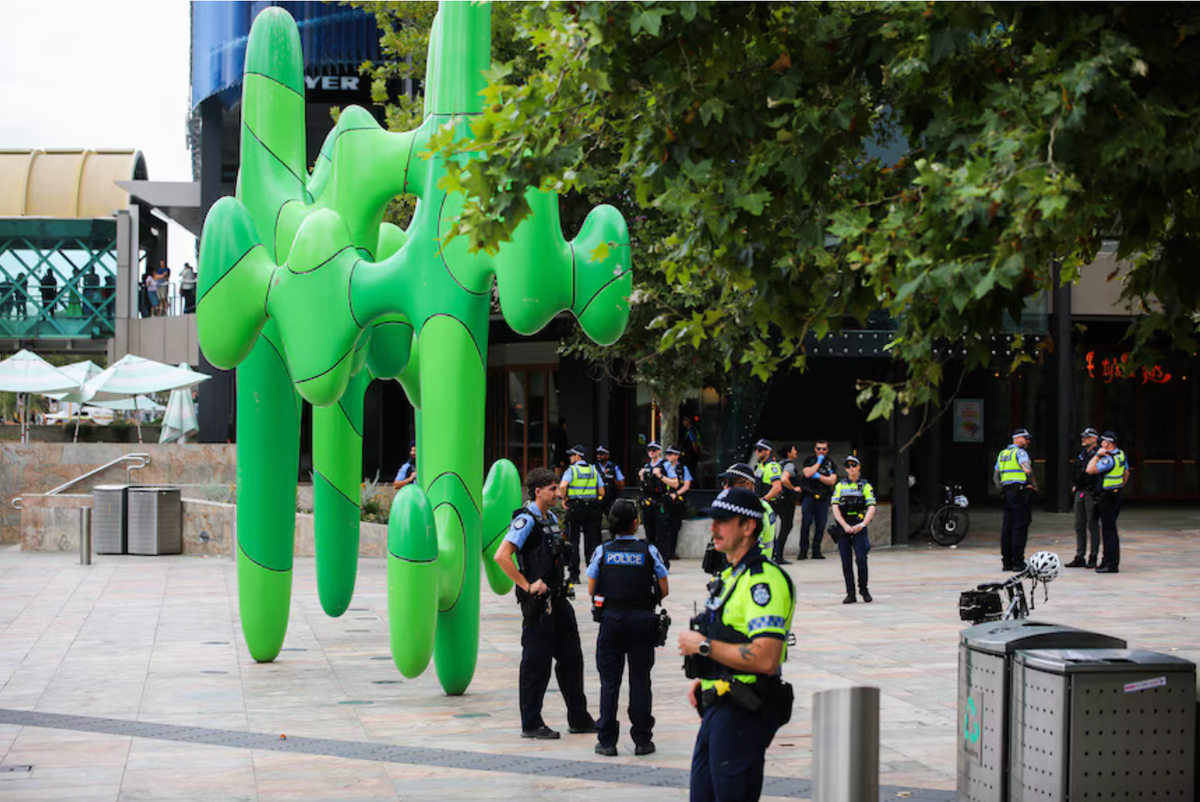
If Perth has an iconic landmark, the sculpted green cactus opposite the city’s main train station has a claim to be close to the top. Set at the foot of Forrest Place, the site of night markets and sports curtain-raisers as well as the starting point for most protests, it might not be Bondi Beach - or even Instagram’s blue boat house - but it’s pretty iconic for Perth.
This morning, it became the site of WA's first terrorism charge.
Many a time over the years, while staring out the train window as it hisses away from Perth’s central square, I’ve idly speculated about the possibility of a terror attack disturbing the balmy calm - maybe even a train derailment like Madrid or London. The same refrain always replied in my mind - it’s not gonna happen in Perth.
The national media evidently started from the same assumption last week. They were certainly slow off the mark when a man clad in black (albeit a t-shirt with an Indigenous butterfly motif) hurled an explosive into a crowd gathered to protest Invasion Day last Monday. If you’re not from WA, and on social media, you might have heard more about whether you’ve heard enough about the bombing than you’ve heard about the bombing itself.
If you’re in Perth and reading the news, you’ll know about it, but you’ll also know that you’re not supposed to see it as that significant. The ABC coverage has been exemplary (not often I give them that kind of credit), and The Australian put it on the front page over the weekend, but in The West Australian - no editorials, one opinion piece.
Compare that to the month after Bondi, where it was impossible to pitch the West any other story as senior reporters were scrambled not just to print the polemics of any passing political lobbyists, but also expected to turn around and lightly filter them to repackage as their own opinion pieces.
When a lighter shade of terrorist came home to roost in the Perth CBD, it was on the front page for a couple of days, but by Thursday last week, three days after the attack, it was relegated to a back page with a headline framing the story about a government Minister “rejecting protestor concerns” - a surefire signal from the West about where their sympathies lie. Needless to say, for literally three weeks after Bondi there were front page banners every single day about the terror attacks there. Sure, no one was killed in the Perth CBD last Monday - but you’d think a home-made grenade being tossed into a crowd like something out of The Troubles would make more of a dent in the current context.
Sure enough, you can cue days of local coverage of the tragic alleged murder-suicide committed by parents of autistic children - truly poignant and lurid, sure, but one can’t help but feel that the family’s home in what was quickly dubbed one of ‘Perth’s most expensive’ suburbs (and the fact the dad and kids went to one of Perth’s most exclusive private schools) fueled the show of sympathy. Certainly, WA Opposition Leader Basil Zempilas was ready to extol extensively on the tragedy at a real life press conference, just days after the ABC reported he refused multiple requests to comment on the attempted bombing in Perth.
Zempilas restricted himself to the first bullet point in his weekly ‘Top 10’ opinion piece in the West Australian on Friday (he rounded it out with his final three bullet points on, respectively, the tennis, the cricket and the AFL). Perth state MP John Carey does not appear to have made any public comment about the attempted bombing in the heart of his inner city electorate, although he found time to post summer holiday snaps from Sydney amidst his relentless hyping of his efforts as Housing Minister.
The WA Premier held a presser hours after the attack, and was in the media again today announcing a determination on its terrorism status from federal police. It will be interesting to compare the response now it's official.
Lidia Thorpe, who introduced a motion in the Senate on Tuesday to commemorate the bombing, quickly called out the “glaring double standards” as reflective of “entrenched racism.”
“When violence is linked to Muslims, the word ‘terrorism’ appears in headlines almost immediately,” she argued compellingly in the first media release I received on the topic. “But when First Peoples are targeted by white supremacists, the response is silence, minimisation and delay.”
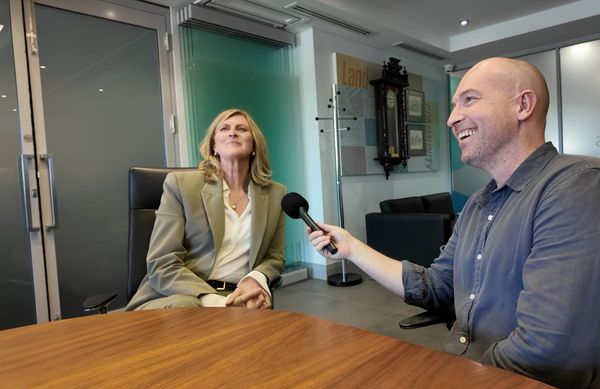
“We know that some of the big commercial privately owned outlets, media outlets are part of the problem in this country - they are complicit in spreading racism,” she told me in the interview embedded at the top of this post. “And as we see it in the media, we also see it in the parliament with those certain politicians that continue to spread hate and racism about Aboriginal people.
The WA Greens, meanwhile, demanded the attack be investigated as terrorism, which it duly was. “[People] are right to wonder if the response would be different had those targeted not been First Nations,” state MP Jess Beckerling stated.
Politically, this is undoubtedly true, as Daniel James eloquently argued in Crikey last week. But in national media, another double standard is due just as much critique in my experience - the view that east coast media elites have of Western Australia as functionally another country when it comes to coverage.
I wasn’t in Perth on Monday, because I’ve been out in Kalgoorlie, in the heart of WA’s goldfields. The night before this happened, while people were preparing to celebrate Australia Day, an Aboriginal man died after being tasered and restrained by police. There was limited local coverage, and little more than that.
As with Invasion Day, there were relevant local factors constraining the coverage to some extent - in this case, family members who told me they did not wish to speak publicly. The Invasion Day coverage got off to a slow start in mainstream media because the Police Commissioner didn’t come out with the Premier to convey the severity of the threat until after east coast bulletins and print deadlines - and then the following day was taken up with a lengthy court hearing that concluded by suppressing key details about the perpetrator’s identity. On this occasion, the pitch may also have been queered slightly by a schism in the organising of the day’s event, with leading First Nations advocates disavowing the current organisers’ criticism of police after the Commissioner hosted a meeting attended by two dozen Noongar leaders - none of whom I’m told were at the Invasion Day rally.
But it’s also the case that the Guardian has not had a reporter based in Western Australia for over a decade. They’ve conducted multiple hiring rounds for state reporters up the east coast in in recent years. But it’s not Queensland, New South Wales or Victoria where you’ll find the highest rates of Aboriginal homelessness, child removal and incarceration. That’s Western Australia every time.
The Guardian does have Ballardong Noongar woman Sarah Collard as an excellent Indigenous Affairs correspondent, but she's based in Sydney these days. And while the North West Shelf imbroglio and the WA government's overt lobbying for weaker nature laws got the Guardian's environment desk's attention, it came arguably too late to do anything but catalogue the effects of WA's untrammelled crony oligarchy.
When one the country’s most progressive mainstream publication doesn’t think WA is important enough for on the ground coverage, bar the odd freelance piece or syndicated copy from one of the couple of news wire journalists stationed here, you’re not going to hear about it. And just because the Guardian is the the first tab I typically open in the morning, I’m not alleging it is the most influential - it’s merely a case study in news room priorities and prejudice. Editor Lenore Taylor’s failure to consider Western Australia is symptomatic of the national attitude, and also means that the smattering of actual journalists left in Perth have less ballast on the left.
Instead, insofar as it still matters (for the purposes of this critique, at least), it’s still the West that sets the terms of the discourse locally. And trust me, Bondi or no Bondi, you’ve got bugger all chance of making them care about what’s happening to Aboriginal people these days. After a few halcyon years of editorial policy that called for change (to the date, and other less superficial signifiers), with one of his final acts as a media mogul Kerry Stokes stayed ahead of the curve by tacking sharply rightwards once again last year and installing Chris Dore as editor-in-chief.
Over the course of the last ten days, thanks to outcry on social media and some staging from Lidia Thorpe, there has been a correction, and by the time police finally designate it terrorism I’d say we can expect that to be national news again. It will be interesting to see whether more of the usual suspects feel obliged to weigh in at that point. But until media are willing to give weight to WA, the causal factors of attacks like this will remain below the surface - until they suddenly explode, just where we least expect them, once again.
You can subscribe to The Last Place on Earth podcast via RSS, Spotify, Apple, Audible, or wherever else you get your podcasts.
Email subscribers to The Last Place On Earth will be the first to know when a new episode drops.